
What’s Happening?
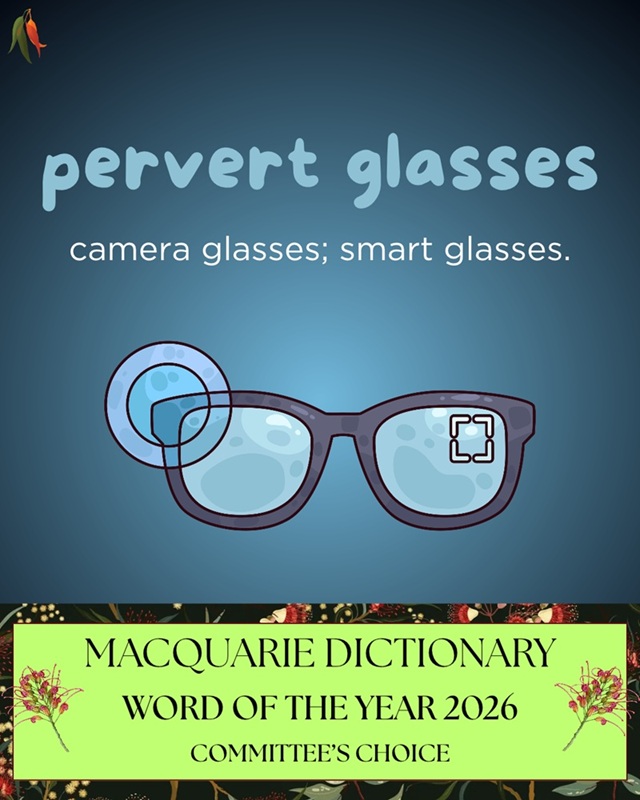
The public has agreed with Macquarie Dictionary’s selection committee, choosing pervert glasses as Australia’s People’s Choice Word of the Year. The dictionary announced the results on Tuesday, 24 November 2026, confirming the expression also won the committee’s annual award.
Pervert glasses is a colloquial nickname for camera-equipped smart glasses, linked to concerns about recording people without permission.
The winning term was drawn from new entries and meanings added to the Macquarie Dictionary Online.
Why It Matters
The matching results suggest that concerns about technology and personal privacy have influenced both the public and language experts.
Rather than celebrating a new device, the chosen expression questions how wearable cameras might affect people who are unaware of being recorded.
The committee linked the nickname to broader concerns about artificial intelligence, public surveillance, and rapid technological development.
“The coinage pervert glasses is a succinct reflection of the state of the world in 2026 in so many ways. On the one hand, we’ve seen a massive acceleration in the capabilities of AI and products that integrate it. At the same time, the undeniably critical nickname mirrors the widespread calls to hit the brakes on this seemingly unchecked development. The name represents the year we’ve all endured, with AI, the manosphere, increasing surveillance in supermarkets, and more. Sure these new gadgets might be marketed as smart glasses or camera glasses, but it seems to us that pervert glasses paints a more apt reflection of the year.”
Local Impact
Australians were invited to vote through the dictionary’s website, allowing everyday language users to influence the annual result.
The outcome reflects how public opinion can shape the recognition of new expressions, particularly those linked to social concerns.
For Australians encountering smart glasses in everyday settings, the winning term also raises questions about privacy and consent.
By The Numbers
- 19 shortlisted expressions: The selection covered digital technology, relationships, medical terminology and cultural changes.
- 3 preferred words: Each voter could nominate their top three entries through the online ballot.
- 3 years running: The public has now agreed with the committee’s winning selection for three consecutive years.
Zoom In
While pervert glasses claimed the main awards, the committee’s honourable mentions demonstrated the range of language changes recognised this year.
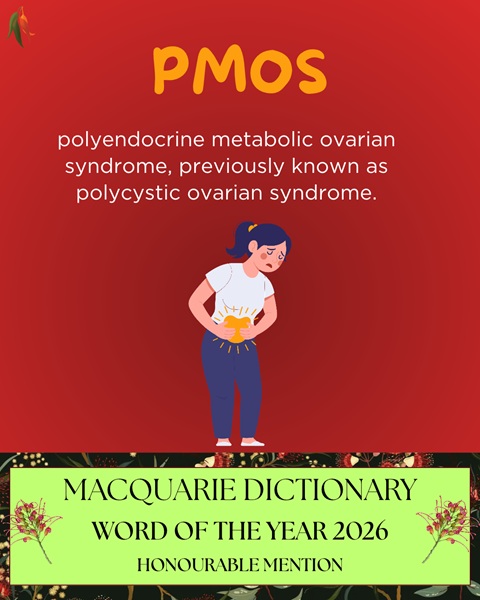
PMOS, or polyendocrine metabolic ovarian syndrome, was included following efforts to replace the previously used term PCOS. The condition may have genetic causes and is associated with irregular menstruation, ovulation problems, acne, excess hair growth, insulin resistance and obesity.
The committee said the change demonstrated the importance of accurate medical language.
“As awareness of medical misogyny (a WOTY 2025 honourable mention) spreads, we hope to see more terms like PMOS entering the dictionary. It shows the power that language can hold, both negatively in the problems caused by the commonly misleading term PCOS, and positively in how this decade-long Australian-led campaign to rename this condition was recently adopted worldwide.”
The word agentic also received recognition, describing something capable of acting or making decisions independently, especially artificial intelligence.
According to the committee, its increasing use reflects the growing presence of AI tools that can carry out tasks with greater independence.
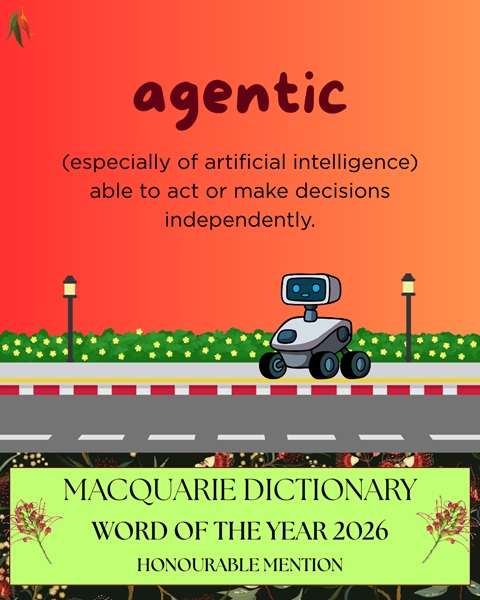
“While it might not be the most flashy, funny, or socially impactful word on the surface, agentic has seen an exponential increase in usage over the last 12 months. Where 2024 and 2025 saw the development and massive spread of large language models, the release of agentic AI tools such as OpenClaw and the mischief they recently wrought has brought this otherwise very technical term firmly into the mainstream.”
Another expression, Marrickville pause, describes people temporarily stopping their conversations while aircraft fly over the Sydney suburb. Unlike the other selections, its origins are tied to a specific local experience rather than changes in digital technology.
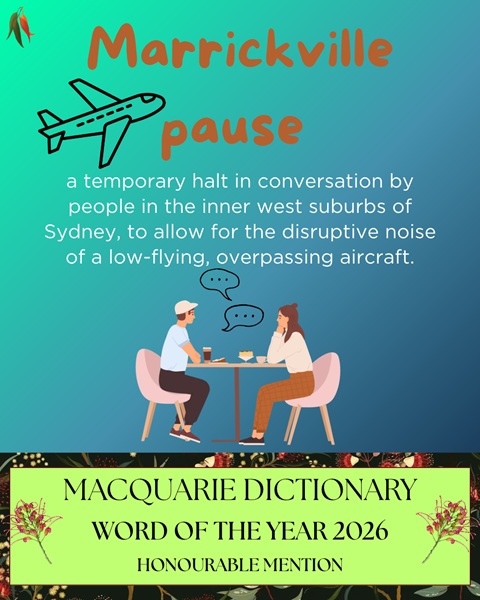
“It is undeniable that we are facing major cultural shifts in the digital world, and as a result, seeing huge language innovation at an international scale. Marrickville pause represents a departure from this trend – a highly localised term for a purely physical phenomenon, but one that is so universally experienced by people who spend time in the area.”
Zoom Out
Public voters also recognised expressions describing the effects of digital dependence and frustration with AI-generated content.
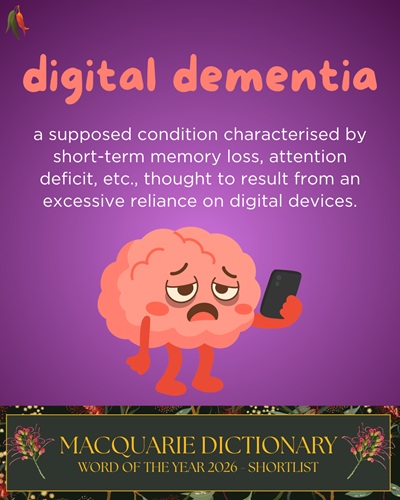
Digital dementia refers to supposed cognitive problems linked to excessive technology use, although the term is not a medical diagnosis.
“Digital dementia is, of course, not a real medical diagnosis but that hasn’t stopped the fear of an increasing reliance on digital devices from resonating deeply. People are finding that they’re struggling to navigate without Google Maps and to make and remember plans without iCal. It will be interesting to see if all of this outsourcing does in fact lead to impaired cognition in the long term.”
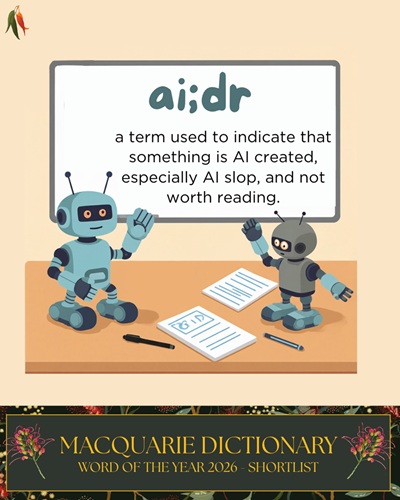
Meanwhile, AI;DR is used to dismiss online material considered AI-generated and not worth reading.
Its meaning follows the familiar TL;DR abbreviation, which indicates that something is too long to read.
“A nice play on TL;DR (a code for too long; didn’t read), AI;DR gives fellow readers an instant heads-up that the text to follow is what they consider to be AI slop. As the sheer volume of AI generated text is ever-increasing, this succinct code will become a much-welcomed time saver.”
The remaining shortlisted entries included analog bag, boy kibble, boysober, choppelganger, creaming, grwm, human-in-the-loop, limbs, nudify, safe phone, shark band, terramation and vertical drama.
Together, the selections show how Australian vocabulary continues to respond to social habits, digital culture and everyday experiences.
What To Look For Next?
The agreement between public voters and the committee could indicate that emerging technology will remain an important influence on Australian language. As new devices become part of everyday life, public reactions may continue producing expressions that question their social impact.
Macquarie Dictionary’s future annual selections will provide another indication of which changes matter most to language users. The complete 2026 shortlist and word definitions are available through the Macquarie Dictionary website.