
What’s Happening?
For Toowoomba renters, rising housing costs are now measured in working weeks, not only dollars. Everybody’s Home says the pressure is spreading across incomes, from trainees to workers earning six figures.
Its 2026 Priced Out report compared rental affordability across cities and regional areas. The report covered annual incomes from $40,000 to $130,000.
It found that rent now consumes a large share of earnings across several income levels.
Why It Matters
Every rent increase leaves less money for groceries, energy, health care, child care and other essentials. For lower-paid workers, the added cost can absorb the equivalent of an entire annual leave entitlement.
Everybody’s Home spokesperson Maiy Azize said the strain had grown steadily, rather than arriving as a sudden shock. She said renters were reaching their financial limits after years of increases.
“Rising rents are costing Australians more of their working days and pay than ever before. We’ve seen rents rising every year for years now. Our rental crisis isn’t a new phenomenon or a policy shock, it’s a long-term trend that’s been compounding, and there’s only so much renters can afford to pay before they hit breaking point.”
She said the pressure now reaches beyond people on the lowest incomes, including essential workers and professionals.
“Rents have been running away for years with the pain spreading well beyond people on low incomes. Essential workers, professionals, and even those on six-figure salaries are finding it harder to pay the rent right across the country. Our report shows in capital cities and most regional areas, people on the lowest incomes would have to spend the majority of their income on rent. Middle income earners are losing well over a third of their income to rent in most areas.”
Local Impact
Toowoomba sits within a shared regional group alongside Ipswich and Queensland North Coast.
While it sits below the five highest-ranked areas, local renters still face a heavy income drain. This burden remains strongest for people on modest wages.
However, the pressure does not disappear as salaries rise.
Azize said regional Australia could no longer be treated as a reliable lower-cost option. The warning matters for both lower and middle-income renters in Toowoomba.
“Regional Australia is no longer a rental refuge, and in many areas, rents are now pricier there than in capital cities. Whether in northern WA or towns on the eastern seaboard, renters are being forced to choose which essentials to sacrifice just to make the rent.”
By the Numbers
- Toowoomba shares nineteenth place with Ipswich and Queensland North Coast. Median rent consumes 74% of a $40,000 income.
- At $70,000, the grouped share ranges from 46 to 47 per cent. It falls to 34 per cent at $100,000 and 27 per cent at $130,000.
- National median rent has risen by $48 weekly since March 2025, adding almost $2,500 yearly. For a trainee on $40,000, that increase equals nearly 4.5 working weeks. It equals three weeks for a childcare worker on $70,000 and two weeks for a social worker on $100,000.
Azize said the added cost was taking both time and spending power from workers. She said renters were paying more without gaining better homes.
Workers are losing weeks worth of their time and paycheques to fund rent rises. National rents are almost $50 extra a week compared to 18 months ago. For someone earning $40,000, this rent increase would chew up nearly four and a half weeks worth of their working year. For most workers, that’s more time than they get off all year.
These are weeks worth of income that can no longer go towards groceries, energy bills, healthcare, childcare or other essentials. Renters aren’t paying more for a bigger or better home. They are giving up more of their working year to live in the same home they were renting a year earlier or one that’s worse.
Zoom In
Australia’s five highest-ranked rental markets were Northern WA, the Gold Coast, Sydney, Sunshine Coast and Perth.
The full ranking shows regional areas sitting beside, or above, several major capitals.
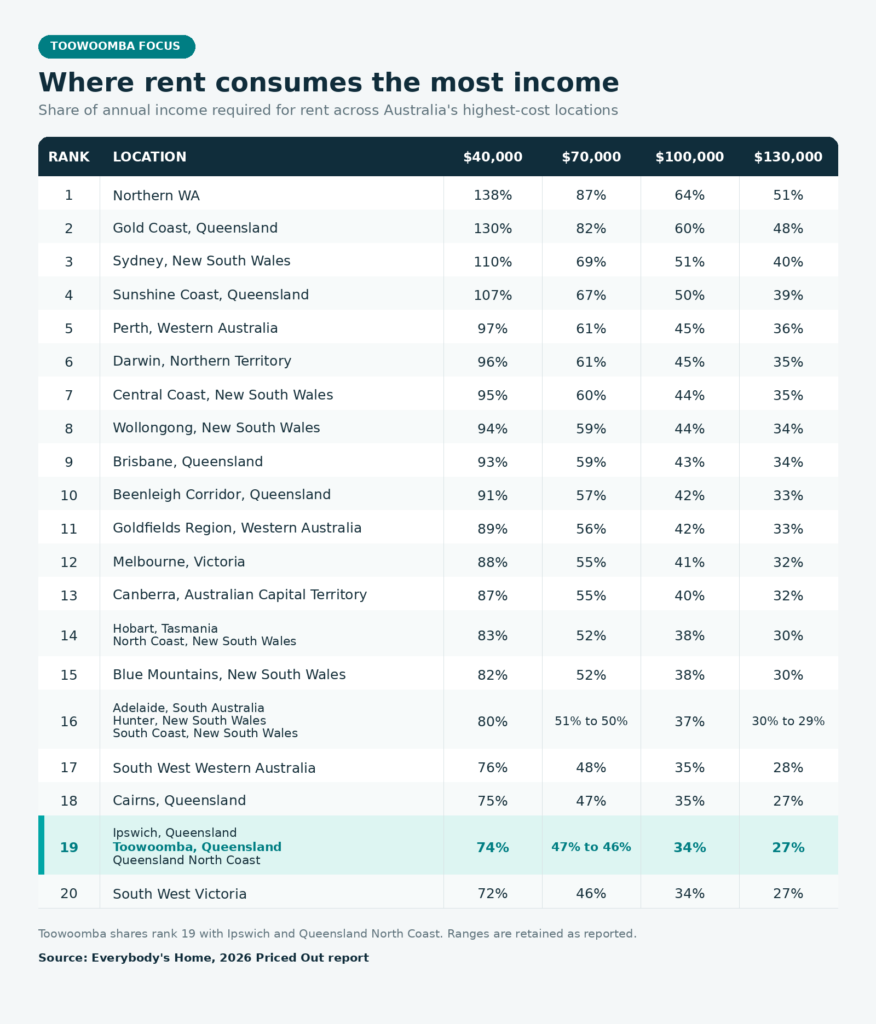
Shared rankings contain more than one location, while ranges reflect different results within each grouped row. The report includes other regions and income ranges.
Zoom Out
Across Australia, median rent consumes 89 per cent of a $40,000 income and 56 per cent at $70,000.
The share is 41 per cent at $100,000, while a $130,000 earner faces 33 per cent. Even six-figure earners can spend more than 30 per cent of their income on rent.
Everybody’s Home links this pressure to decades of limited public and community housing. Azize said private development would not fill the gap.
“We are in this rental crisis because of decades of governments walking away from public and community housing. These are the homes that don’t price out renters, and they’re the homes that private developers won’t build. The solution is actually pretty simple. The federal government needs to build public and community homes at scale. Australia needs nearly one million of these homes within the next 15 years.”
What To Look For Next?
Everybody’s Home is calling for more public and community housing, alongside immediate help for renters.
It wants limits on rent increases, better rental standards and stronger support for people on the lowest incomes.
“While we wait for more public and community housing, the federal government needs to work with states and territories to limit rent increases, improve rental standards, and make sure those on the lowest incomes have enough money to live. The federal government has shown that it can take action to help people buy their first home, now it must help everyone afford to rent one.”
Future reports will show whether these measures ease pressure on Toowoomba households. Slower rent growth would leave more income for daily essentials.